What’s Your Type?
Social Media use can powerfully affect our emotions, and their design features can reinforce the negative or positive impact of our digital experiences.
My role was to investigate the impact of social media design and its usage on people’s emotional states and lived experiences.
Collaborators
Jurine Gong (UX Research)
Yu Ting (UI Design)
Tom Dai (Project Management)
Role
Ideation
Literature Review
User Research
Tools
Pencil and Paper
Miro
Figma
Microsoft Excel
Qualtrics
Timeline
Mar 2023
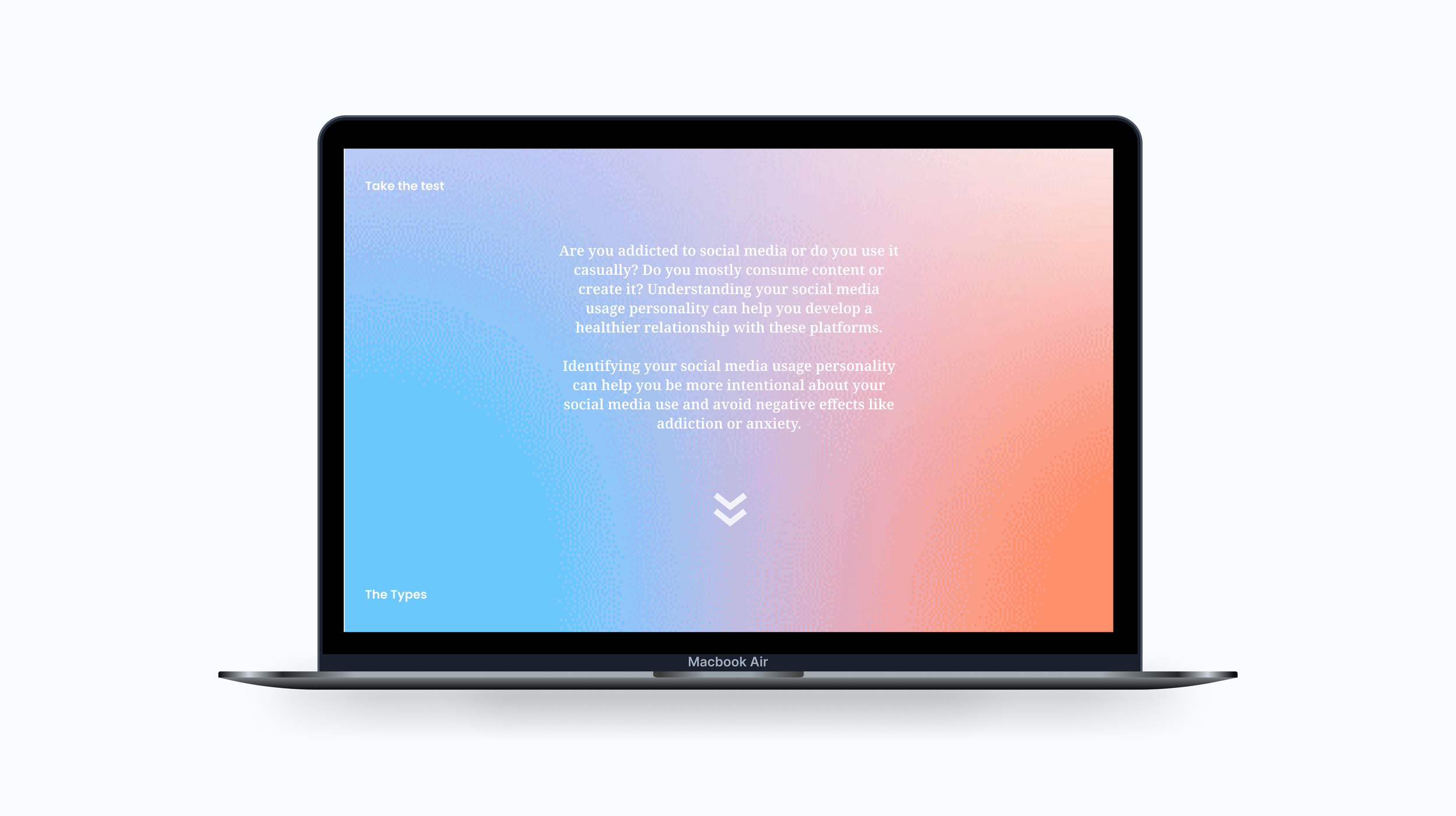
Final Prototype
The Challenge
How often do people realize the extent of social media's effects on their daily lives, and what do they do about it?
Why does it matter?
Notifications, comments, likes of online posts, live videos, photo filters, etc., are digital affordances that change how users interact, think, and feel for better or worse, affecting their moods occasionally.
Image Courtesy: Figma Community
Social media use has been linked to negative emotions such as anxiety and depression.
And such impact of social media is likely to become more profound as the user base keeps increasing and the algorithms continue to upgrade.
After 40+ responses from a survey and 4+ interviews, we finally understood…
What do people really feel about using social media?
“I think sometimes I have fear around accidentally clicking on the wrong thing and reading something I don't wanna read, and I feel a little bit stressed out when that happens.”
“I feel like when I check social media in the mornings, I'm not really focused throughout the day, and the days that I don't check social media in the mornings, I feel a lot more productive.”
What do people do to deal with their feelings?
“One of the things I do is, like, if I'm following a page, and clearly somebody else is following that page for the sole purpose of trolling, I just block that person. I'm not gonna engage in arguments with somebody like that.”
But interviews about emotional talk can be challenging…
Difficult to recall from memories
Not comprehensive enough to analyse
An Interviewee with flash cards to identify the emotional affects of social media.
In our process, we used the flashcard method to help interviewees recall their experiences and ran a pilot interview to test out the questions.
Based on this activity, we continuously versioned the questionnaire during the interview process to capture users’ good and poor experiences with social media.
Also, prior to the interviews, we turned to Google to understand the workings of social media practices.
We used the Miro board to capture all our research themes and identify the challenges in understanding the emotional states of social media users.
What did we learn?
Hedonistic Feelings:
Receiving recognition and appreciation in the form of likes and comments produces a hedonistic effect on emotional well-being and short-term elation among users.
Platforms are designed to be used for longer periods so that it increases the platform’s traffic and profits.
Image Courtesy: Figma Community
Algorithmic Control:
Users believe that they make decisions stemming from their freedom of choice and will.
Instead, such decisions result from a set of algorithms trained by social media companies.
Surprisingly, our assumption was wrong. People rarely perceive themselves as being addicted to social media.
During our interviews, we also found that people are not always affected negatively by social media use and very few identified themselves as addicted to social media.
We used Google Sheets to categorize our interview findings and themes.
Positive Impact, we knew but never assumed that people would acknowledge…
Helps them form personal connections.
Informs them about news and general tidbits and entertains them through reels, images, and memes.
Negative impact that was dependent on user habits and social media settings…
Continued use affects their productivity.
Privacy and lack of authority in social media settings are concerns that affect them.
This insight led us to two How Might We Questions…
In our research, we did not find hard evidence of people’s negativity in social media usage. However, the process taught us how human emotions tie in with social media usage.
Emotions are able to alert us to things that have implications for our concerns and values. The understanding of such emotions that imply values and meaningful goals, along with an understanding of these goals and values itself, is necessary for pursuing them.
With this insight, we framed the How Might We questions based on educating people about their social media use and informing them of strategies.
How might we help people acknowledge their mental states using social media platforms?
How might we inform more ethical and equitable strategies to use social media platforms positively?
Design Goals & Intended Outcomes
To help people understand what kind of social media user they are.

Design a short, interactive personality quiz.
To introduce a sense of relatedness to inform that they are not alone.
Develop an interactive user story.
To increase a sense of control over their use of social media.
Educate them on ethical personal strategies to track their habits.
Curating a quiz is not easy. We took inspiration from our interview process and developed a scoring method.
We created a scoring scale for the quiz
Based on our scoring ranges, we developed three user types that corresponded to the answers in the quiz.
Sketches and Final Designs
We create basic sketches with a focus on creating visually impactful designs. Our goal was to use calming colors and animations for engaging the users emotionally.
At the end of the quiz, users learn about their “type”. Corresponding to their “type”, the website reveals easy strategies for combating the negative impacts of social media use.
A social media personality quiz allows users to answer simple and quick questions.
Outcomes
Conscious-effort of being aware
The quiz is the initial round of preventive measures to understand the daily habits of an addictive social media user. By helping identify a pattern in their social media usage, people can make a conscious effort to improve their behavior.
Informed decision making
User stories provided through the platform are a reminder that people are not alone and anyone can fall prey to the attentive economy of the social media giants. By educating themselves, people can arm themselves with reliable information.
Reflections
Mental health is a sensitive topic
Because of our small sample size of interviewees, our findings could have a biased result. We also did not include different perspectives and opinions of mental health professionals.
Limited User Types
The three user types may not encompass all kinds of social media users out in the real world. But it did help us create an example of how we can inform people about their usage.
Absence of User Testing for Increased Impact
This brief project showcased my skills in research and storytelling, emphasizing the initial phase of product ideation—a functional MVP. The next step would be to conduct a user testing.
Characters reflecting emotional feelings designed by the UI Designer in this project